
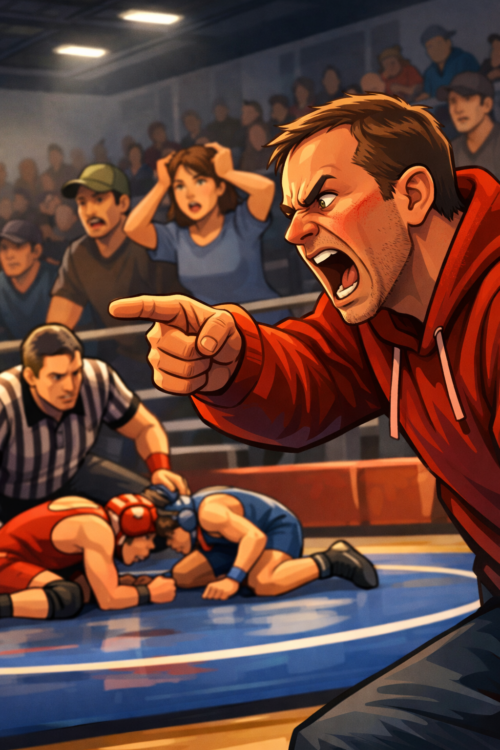
It’s Sunday. The Falcons are on (or insert your team here). It’s a big game. Expectations are high.
The team is driving for the game-winning touchdown. The quarterback drops back… and throws an interception.
What the F$@#!!!
Sound familiar?
If you were casually watching two teams you didn’t care about, it wouldn’t affect you. But when it’s your team, the emotions hit different.
Oof.
The stakes feel even higher. Your heart races. Your blood pressure rises. Your nerves are on edge. You’re not just watching a match—you’re emotionally in it with them.
And in the heat of the moment, even good intentions can turn into frustration, anger, or disappointment. This can affect the outcome of their match and sometimes even your relationship if taken too far.
Most of the time, parents don’t mean for it to come across that way. But emotion seeps through tone of voice, facial expressions, and body language. When we’re emotionally charged, it becomes hard to stay level-headed and say the right things in the right way.
Why Does This Happen?
Of course we want them to win. But why does this match feel so important?
We want them to be happy.
We want them to grow confident.
And sometimes, deep down, we fear that losing an individual match might damage that confidence.
We also carry expectations. There’s a picture in our head of how the match should go. When it starts drifting off script—when mistakes pile up, when momentum shifts, when we see our child getting emotional—we feel anxious. That anxiety can quickly turn into frustration or panic.
And sometimes it goes even deeper than that…
Maybe, subconsciously, you worry about what others think—because your child’s performance feels like a reflection of you.
Maybe you believe they should be progressing faster and your patience is wearing thin.
Maybe it’s simply that they feel like an extension of you out there on the mat… so when they struggle, you struggle. When they lose, it feels like you’re losing too.
That lack of control creates tension. Tension creates anxiety. And anxiety often shows up as frustration or anger in our voice.
How This Can Affect Their Wrestling
Cheering is one thing. Yelling is another.
When you’re yelling, they can’t clearly hear their coach. They need to learn to tune into one, consistent voice. Even if you think you’re helping by repeating the same instructions—just louder—what you’re really doing is adding extra noise.
If you’re also their coach, it becomes even trickier. They can’t easily separate “parent voice” from “coach voice,” so your emotional state directly affects how they receive instructions.
What many parents don’t realize is that every time you yell, your child pauses—just a little.
They may glance toward you.
They may hesitate.
They may become more cautious.
You are an authority figure in their life. They don’t want to disappoint you. So instead of fully committing to the next position or taking a risk, part of their attention shifts to not making a mistake in front of you.
Here’s a powerful exercise: record yourself sometime during a match.
How much panic is there?
How much disappointment?
What if there are 30 seconds left: “You gotta go! Shoot! What are you doing?!”
If you sound panicked, they feel panicked. It’s very hard for a child to learn to be calm under pressure when the adults around them are freaking out.
What You Can Do As A Parent
Someday, they won’t be wrestling anymore. These moments are temporary in the grand scheme of life and you’ll want to cherish the experience.
-
Watch from the stands. Distance reduces the temptation to coach or yell.
-
Let go of expectations. Not lowering them—but just like a wrestler should, approach each match fresh by just focusing on execution and not outcome.
-
Adopt a growth-over-results mindset. Losses teach. Mistakes teach. Sometimes getting scored on in a position becomes the lesson that wins a bigger match later. Or provides a lesson on how to bounce back.
-
Keep perspective. Ask yourself: How important is this match really?
Unless it’s the NCAA finals or the Olympics, these matches are part of the learning process. Some matter more than others, and it’s okay to get excited. There is nothing wrong with cheering them on for a big match.
My point is to have some perspective. Don’t get yourself (or your wrestler) so worked up that it affects their performance in a negative way.
When You Feel Emotions Rising
Just like the “Next Point Mentality,” article I sent last week, the first step is recognizing when emotion is taking over.
Ask yourself:
Am I cheering them on… or something else?
If you are the coach, think “what does my wrestler need right now?”
And when the match ends—win or lose—give both your child and yourself time to settle down.
Don’t let your emotions become another obstacle they have to manage.
Matches will come and go. Wins and losses will fade.
STAY IN THE LOOP