
In wrestling, there are no timeouts.
No time to feel sorry for yourself.
No time to feel sorry for yourself.
No time to replay what just happened.
No time to panic about how far behind you are.
You have to stay present and keep wrestling if you want to win.
This mindset is referred to as having a Next Point Mentality — but it’s not just a wrestling lesson. It’s a life skill.
In life, adversity is unavoidable. Stress happens. Setbacks happen.
The goal isn’t to avoid them, but to be prepared to respond, adjust, and keep moving forward. It’s not about what happens — it’s about how you handle it.
That’s also the reality of wrestling. One definition of the word literally means “to struggle.”
A big part of a coach’s job is teaching athletes to embrace that struggle instead of fearing it. Parents play a critical role too — not by removing hard moments, but by reinforcing the belief that their kids are capable of facing them and bouncing back. That’s what builds real confidence.
So we teach this is through developing a “Next Point Mentality”.
Instead of staying stuck in the past, a wrestler learns to reset, return to the present, and focus what it takes to score the next point.
It’s a shift from emotions to action. From feelings to problem-solving.
How to Mentally Reset
Wrestling is an emotional sport. It’s easy to get upset and get mentally stuck in what just happened. It helps to do something physical to bring the wrestler back to the present moment.
The process is straight forward:
-
Recognize – Simply be aware when you’re no longer focused and are wrestling emotionally.
-
Relax – Breathe. Slowing your breath restores a sense of control.
-
Refocus – Use a technique called Tactile Grounding – shift attention to something you can physically feel to interrupt the stress loop and pull the mind back into the here and now.
-
Shake out your arms.
-
Adjust your headgear.
-
Fix your singlet.
-
Once reset, the focus returns to one simple question:
“What’s my job right now?”
Win the next position. Solve that problem. Score the next point.
The Jordan Burroughs Sock Pull
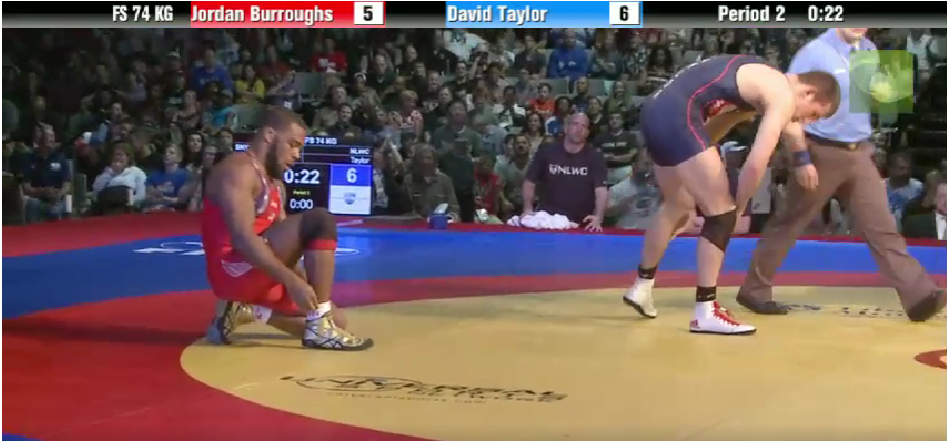
Seven time World & Olympic Champion Jordan Burroughs is famous for a simple reset ritual: pulling up his sock up.
Whenever he was down late in a match, that sock pull was his way of grounding himself and clearing his mind. After that, he was locked in.
And he was 100% after a sock pull. And I mean crazy comebacks. He once scored two takedowns in the last 30 seconds over David Taylor at the US Open. You can watch that match here: https://www.flowrestling.org/video/5490633-74kg-finals-david-taylor-vs-jordan-burroughs
Translating Wrestling Into Life
Being present and focusing on the “next point” is a lesson that extends far beyond the mat.
In life, stress triggers the same emotional spirals. We replay conversations. We relive mistakes. We worry about what might happen. Our bodies release stress hormones, our minds loop, and we get stuck — mentally overwhelmed and emotionally flooded.
In life, we all need our own version of a “sock pull.”
A moment that says: “Okay pause. Let’s focus on what we can control”
Instead of adjusting your sock, it might be taking a quick walk, noticing your breathing, feeling your feet on the ground, pet your dog, take a shower. Anything that anchors you back to the present. And then:
“What do I need to do right now?”
Like any skill, mental resets get better with practice.
It takes reps.
It takes learning to recognize when you’re stuck replaying the past or worrying about the future — and then deliberately bringing yourself back to the present.
Helping Our Wrestlers Learn the Lessons
Wrestling lessons don’t always automatically transfer to life.
Parents play a critical role in helping our wrestlers translate what they learn on the mat into how they handle everyday challenges.
We need to remind them that they can do hard things.
Just like in wrestling, our job isn’t to remove adversity. It’s to help our kids trust themselves when adversity shows up. To remind them, when they’re overwhelmed, frustrated, or stuck in their own heads:
“Reset. What’s your job right now?
Because when they learn how to do that under the lights, in front of a crowd, when they’re tired and emotional and under pressure — they’re also building the skills that will enable them to do it everywhere else.
STAY IN THE LOOP